|
|
|
|
Good morning. The tragedy at CFB Wainwright in Alberta hangs over a high-stakes referendum today about the province’s future. Today’s newsletter looks at that vote, an inflation report and the next wave of AI earnings. |
|
|
|
|
|
|
|
|
|
|
|
|
|
|
|
|
|
|
|
|
|
|
Condos: A major Ontario construction lender says it won’t relax its loan criteria for developers despite a sharp drop in projects and industry calls for more support. |
|
|
|
|
Credit: Canada is on track to become a top-three holder of U.S. government debt before 2028, surpassing China. |
|
|
|
|
|
|
|
|
|
|
|
|
|
|
|
Look at this thing. -/AFP/Getty Images
|
|
|
|
|
|
|
|
|
|
|
|
|
|
|
|
|
1. Independence Day? Albertans vote today on whether they should stay in Canada, or hold a second vote on making separation official. The referendum, which includes nine other questions on topics including migrants’ access to social programs, judicial appointments and the future of the Senate, is the first time the province has put a secession question to voters. |
|
|
|
|
As Calgary-based reporter Matthew Scace writes, it is taking place at a time of tremendous stress on national unity. The leader of the newly elected separatist Quebec government has vowed to hold a referendum on independence, and U.S. President Donald Trump’s oft-shared overtures toward the provinces haven’t exactly calmed the waters. (Oh, and on Friday, The Globe reported about an uptick in U.S. influence campaigns in recent weeks.) |
|
|
|
|
Prime Minister Mark Carney has attempted to blunt Albertans’ frustration with Ottawa since taking office, recently designating a new bitumen pipeline a project of national interest. |
|
|
|
|
Look to Britain to see the price it paid for leaving the European Union, John Rapley argues. Alberta would pay a price to leave Canada, and an bigger price to get back in. |
|
|
|
|
|
|
|
|
2. Spreading the bill: Higher fuel bills have kept Canadian inflation above the Bank of Canada’s 2-per-cent target. Today’s September report might help us see whether those price increases are spreading to more of the things we buy. A consensus of market watchers see annual inflation rising to 3.2 per cent from 3 per cent in August. In a note to clients on Friday, RBC economists said they expect it to hold steady as food inflation eases. |
|
|
|
|
The BoC’s two other key reports today – one on corporate Canada’s outlook and another on consumer expectations – will help paint a fuller picture. Production-cost increases have become more widespread, according to an RBC analysis of industrial prices, but those can take time to reach store shelves. |
|
|
|
|
The reports land nine days before the BoC’s Oct. 28 decision on its trend-setting interest rate. Governor Tiff Macklem warned last week that the longer energy prices stay high, the harder it becomes to look past their effect on inflation. Yet employment has fallen for two consecutive months, leaving the bank to weigh the risk of rising prices against the damage higher borrowing costs could do to an already weak economy. |
|
|
|
|
3. Steely resolve: The stare-down between Canada and Cleveland-Cliffs continues. The U.S. steelmaking giant was firmly in Canada’s spotlight already, locked in a clash with the federal government over its decision to lay off hundreds of workers at its Stelco plants in southern Ontario. Today, investors will also be watching to see how the company is faring in a divided global steel market. Demand is sluggish in China as its property slump drags on, while tariffs have hit imports. |
|
|
|
|
In Canada, Ottawa is continuing to insist the U.S.-based owner of Stelco Inc. must uphold job commitments it made when it purchased the Ontario-based steelmaker – or risk being forced to sell its Canadian assets. The company has said the U.S. tariffs made the layoffs unavoidable, and that it’s ready for a court battle. Obviously, we’ll be listening for comments from executives on the call. |
|
|
|
|
“Everything is on the table and so therefore, I’m always open to sit down with the company and find a solution, but we’re looking at everything that is possible to keep jobs in Canada,” Industry Minister Mélanie Joly said at The Globe defence summit last week. |
|
|
|
|
Neither the government nor the company appear willing to budge. But in goading the federal government, Rita Trichur writes, Cleveland-Cliffs is confusing classic Canadian collaboration with capitulation. |
|
|
|
|
4. Poor signal: Rogers Communications reports third-quarter earnings Friday as shares of Canada’s three telecom giants are under pressure. Rogers shares have fallen about 13 per cent this year, alongside declines of 11 per cent for BCE and 33 per cent for Telus. |
|
|
|
|
As Irene Galea reports, higher bond yields are making telecom dividends less attractive to investors seeking safe income. Higher interest rates could also make refinancing more expensive for the three companies, which carry nearly $100-billion in combined long-term debt. Fierce competition over cellphone prices and stagnant immigration are also making it harder to earn more from subscribers or find new ones. |
|
|
|
|
Rogers has cut back its capital spending plans and intends to sell a portion of its sports holdings as it works to pay down debt. |
|
|
|
|
5. Third-quarter thunder: Earnings season ramps up this week with earnings from Meta, Tesla, Texas Instruments and Netflix. Meta, due on Wednesday, is one of several hyperscalers whose massive spending on AI data centres and infrastructure has accounted for north of $1-trillion. Investors are eager to see that spending turn into profit at some point. |
|
|
|
|
Shares in AI-focused companies stumbled last week, bringing added scrutiny to Meta’s earnings. |
|
|
|
|
Tesla is also reporting on Wednesday. I know company founder and Iron Man cosplayer Elon Musk is likely hyping a possible merger with SpaceX, his rocket company, but the carmaker unveiled a Roadster last week powered with rocket-style thrusters. The electric sports car drove upside down on a ramp using a suction system, and I can’t stop thinking about how this changes the game for drive-throughs. The company promised production would begin in 2028. What could possibly go wrong? |
|
|
|
|
With files from Associated Press and Reuters |
|
|
|
|
|
|
|
|
|
|
|
|
|
|
|
|
|
|
|
|
|
|
|
|
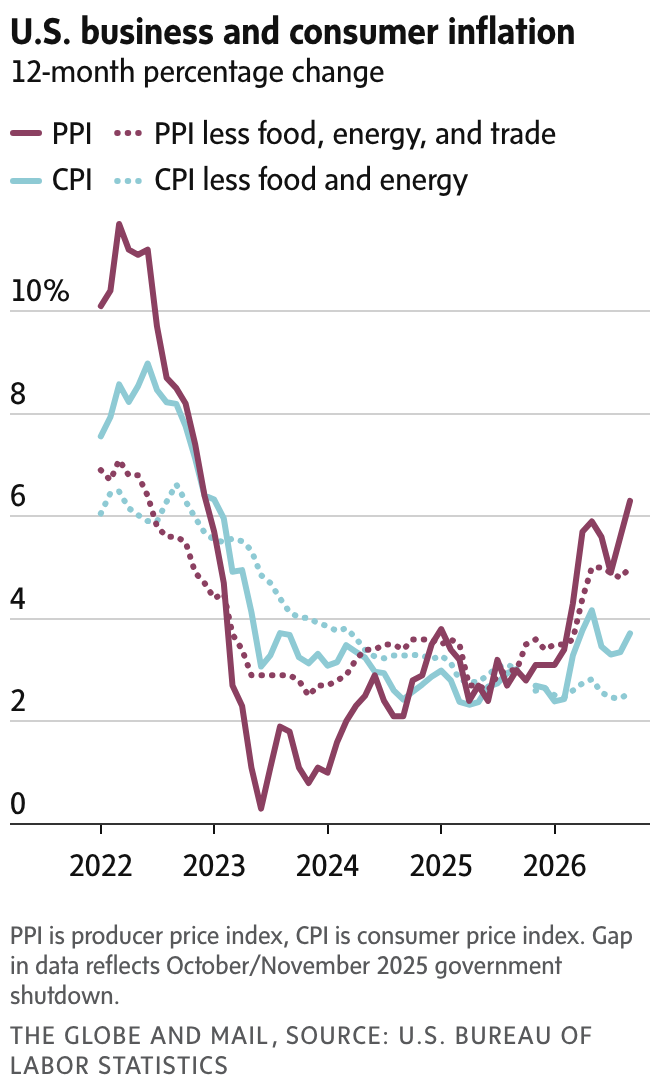
While we try to make sense of Canada’s inflation picture, a “double-whammy” of inflation readings in the U.S. showed both consumers and businesses are feeling the heat of higher prices, Jason Kirby writes. The rapid business inflation increase raises questions around whether they may try to unload more of that inflation pain onto their customers. |
|
|
|
|
|
|
|
|
|
|
|
|
|
|
|
|
 | This is a theft of unprecedented scale for the wine industry in Italy, carried out by a group that was clearly highly organized and well prepared. — Antinori CEO Renzo Cotarella |
|
|
|
|
|
A heist in Italy has hit supply of Antinori red wines around the world. Canada looks to have been spared. |
|
|
|
|
|
|
|
|
|
|
|
|
|
|
|
|
Global markets were mixed as unease over AI’s enormous funding needs weighed confidence ahead of a week packed with earnings. |
|
|
|
|
Wall Street futures diverged with the Dow in the red after major U.S. markets closed sharply lower on Friday, while TSX futures pointed lower. |
|
|
|
|
Overseas, the pan-European STOXX 600 was down 0.82 per cent in morning trading. Britain’s FTSE 100 fell 0.98 per cent, Germany’s DAX declined 1.14 per cent and France’s CAC 40 dropped 1.43 per cent. |
|
|
|
|
In Asia, Japan’s Nikkei closed 0.62 per cent lower, while Hong Kong’s Hang Seng climbed 0.52 per cent. |
|
|
|
|
The Canadian dollar traded at 70.96 U.S. cents. |
|
|