Expecting a Market Correction? This Mega-Cap ETF Deserves a Spot on Your Watchlist
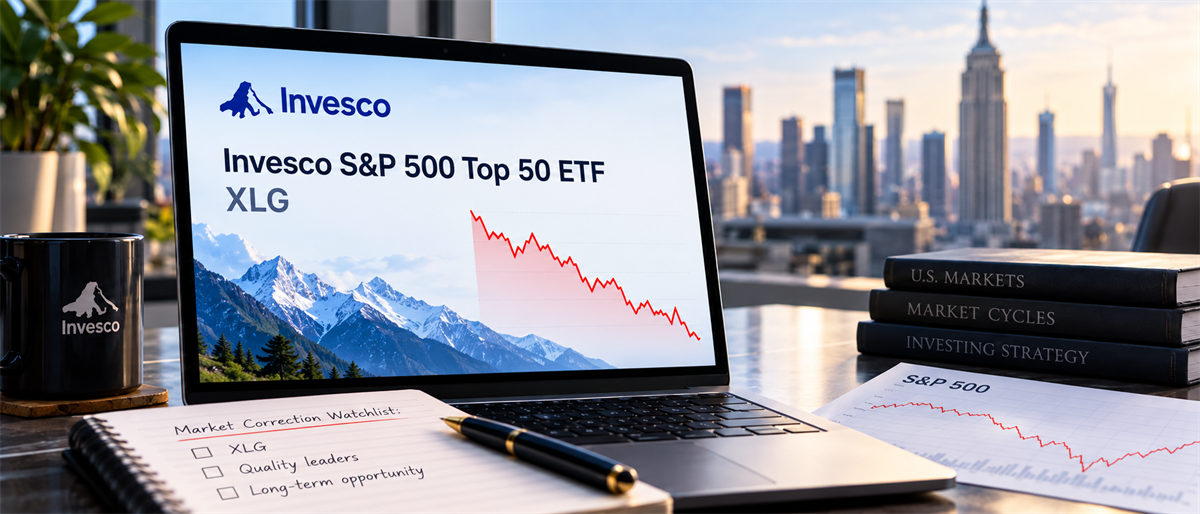
Between souring economic sentiment and elevated borrowing costs, the number of people who believe that the market’s current trajectory is unsustainable is on the rise. According to a recent study by the Allianz Center for the Future of Retirement, nearly three in four Americans now believe the stock market is due for a correction.
As bearish as that outlook may be, it suggests that retail investors are becoming more informed.
“Too often when markets are up, people will assume they will keep going up and pile in,” said Kelly LaVigne, vice president of consumer insights at Allianz Life. “The fact that many Americans are aware that the good times can’t last forever is actually encouraging."
While nobody has a crystal ball, preparing for the inevitable can help soften the blow of a pullback, correction, or outright crash. However, that doesn’t just entail rebalancing, locking in profits, and rotating into more defensive names.
It also calls for dusting off your watchlist so that if and when a downturn occurs, you are prepared to deploy capital into oversold and undervalued positions that are trading at a discount. And one ETF provides exposure to a basket of mega-cap growth stocks that, during selloffs, tend to fall in price more than others: the Invesco S&P 500 Top 50 ETF (NYSEARCA: XLG).
Why Mega-Cap Growth Stocks Could Present Opportunities After a Correction
Outside of a handful of financial firms and consumer staple giants, the S&P 500’s top 50 holdings are dominated by mega-cap tech and communication services names.
Those high-growth stocks—many of which are under the microscope since the advent of the AI trade—have demonstrated steeper corrections than the broader market during valuation- and interest rate-driven downturns.
That was the case during the last bear market in 2022 when the Federal Reserve embarked on an aggressive rate-hiking cycle that disproportionately punished debt-reliant mega caps. That year, while the S&P 500 fell by nearly 25% from peak to trough, members of the Magnificent Seven experienced far more severe drawdowns: Microsoft (NASDAQ: MSFT) lost more than 35%, Amazon (NASDAQ: AMZN) lost more than 54%, NVIDIA (NASDAQ: NVDA) lost nearly 66%, and Tesla (NASDAQ: TSLA) lost nearly 72%.
However, for that very same reason, those mega-cap stocks are capable of outperforming once the market reverses.
Following 2022’s bear market, for example, the tech sector rebounded in 2023 with a gain of nearly 58%. Since then, those four stocks have seen enormous gains, with Microsoft at 145%, Amazon at 208%, Tesla at 232%, and NVIDIA at 1,935%.
But rather than attempting to identify individual winners or rely on ETFs that hold only AI, tech, or Magnificent Seven names, one fund holds the largest 50 names in the S&P 500—regardless of sectors or themes.
Invesco XLG Offers Exposure to the S&P 500's Largest Stocks
The Invesco S&P 500 Top 50 ETF (XLG) tracks the S&P 500 Top 50 Index, investing at least 90% of its total assets in securities that comprise that benchmark.
The fund, which is reconstituted annually, provides cap-weighted exposure to the 50 largest publicly traded companies in the United States.
In addition to the aforementioned names, other top-10 holdings in the XLG’s portfolio include Apple (NASDAQ: AAPL), Broadcom (NASDAQ: AVGO), Alphabet (NASDAQ: GOOG), Meta Platforms (NASDAQ: META), and Micron Technology (NASDAQ: MU).
Together, those 10 companies currently account for nearly 61% of the fund, which boasts $12 billion in assets under management, a net expense ratio of 0.2%, and a dividend yield of 0.6%.
The ETF does present concentration risk, but in a scenario where the major indices have corrected, that aggregation of high-growth names is precisely why it has the potential to outperform.
Tech and communication services account for more than 64% of the fund’s sector exposure. By industry, semiconductors, communications equipment, media, and software account for more than 62% of total exposure. That has resulted in some elevated volatility driven by a slightly above-average beta of 1.06. As a result, the fund has lagged the broader market this year.
But since the XLG is a watchlist candidate for those expecting a correction, it’s useful to look at what the ETF did during 2022’s downturn. From its high that year, the fund fell 27%—more than the S&P 500 but less than the names that make up its top holdings.
Since then, it has gained nearly 142%, compared with the S&P 500’s 118%.
For investors who find themselves among the nearly 75% of Americans expecting a correction, keeping an eye on the XLG can help them prepare for a buying opportunity if mega-cap growth stocks lead the way down during that phase of the market cycle.
Where Should You Invest $1,000 Right Now?
Before you make your next trade, you'll want to hear this.
MarketBeat keeps track of Wall Street's top-rated and best performing research analysts and the stocks they recommend to their clients on a daily basis.
Our team has identified the five stocks that top analysts are quietly whispering to their clients to buy now before the broader market catches on... and none of the big name stocks were on the list.
They believe these five stocks are the five best companies for investors to buy now...
The article "Expecting a Market Correction? This Mega-Cap ETF Deserves a Spot on Your Watchlist" first appeared on MarketBeat.
